The opening of the Gillespie Field annex in 1985 changed what the Museum could undertake. The Ford Building remained the public center of the institution, but it could not comfortably support the disassembly, long-term staging, metalwork, fabric work, painting, and parts storage required by large aircraft projects. At Gillespie, an aircraft could remain in process for years without competing directly with gallery operations. Wings, engines, control surfaces, and incomplete fuselages could be organized around a project rather than moved repeatedly to accommodate exhibitions.

Once an isolated air field, Gillespie has grown along with the area surrounding it.
The hangars also made restoration visible. Visitors saw aircraft with their structures exposed and gained a clearer understanding of the distance between acquisition and finished display. Technical manuals and historical photographs sat beside fabrication tools. Volunteers compared markings, traced missing parts, built fixtures, repaired corrosion, and debated which period in an aircraft’s history should guide its appearance. The annex showed that restoration was neither quick nor automatic. It was an extended process of research, material work, and judgment.
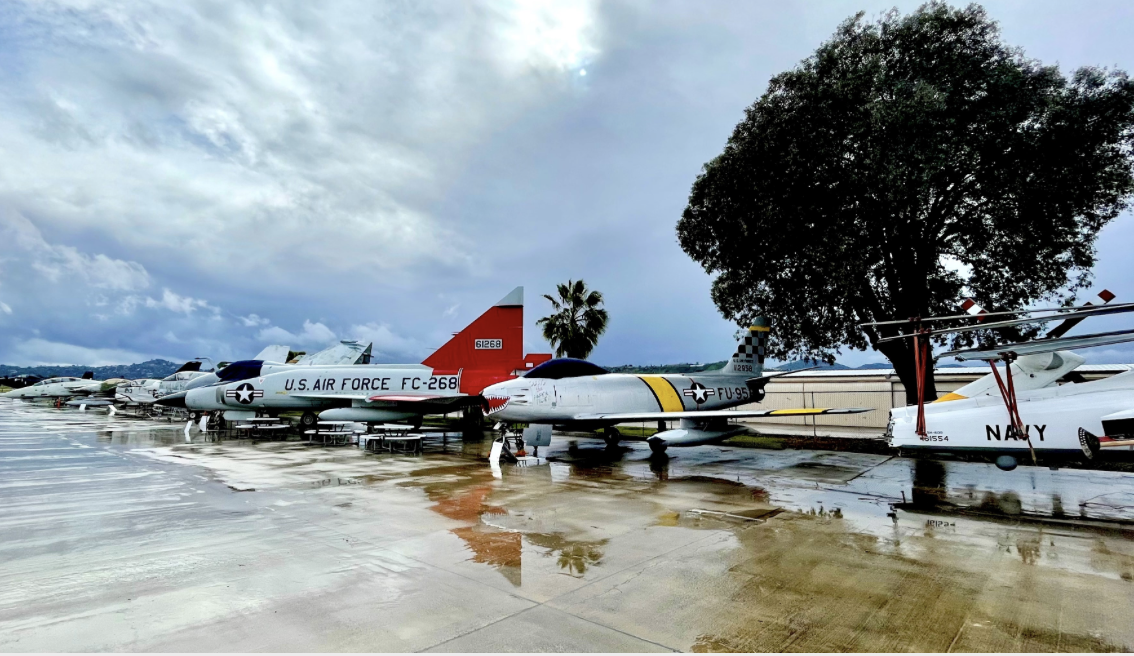
Some of the aircraft on display at the Gillespie Field Annex.
A project completed at Gillespie could eventually return to Balboa Park, travel to another museum, remain at the annex, or occasionally return to flight. In 2003, the Museum prepared its Spirit of St. Louis replica for the seventy-fifth anniversary of San Diego International Airport. The aircraft had not flown since its 1979 tests. Staff and volunteers inspected the structure and controls, overhauled the engine, repaired the fabric where needed, and returned the replica to airworthy condition. On August 16, it flew twenty-seven minutes from Gillespie Field to Lindbergh Field. The flight connected the Museum’s rebuilding after the fire with the city’s continuing identification with Lindbergh and Ryan Aeronautical.

The Museum's Spirit replica taking off from Gillespie Field in 2003.
Restoration in the Ford Building also continued inside Balboa Park. The Museum retained a restoration capability within the Ford Building for projects that could be completed there and provided visitors with behind-the-scenes access for more than two decades. The two locations developed complementary roles. Gillespie provided industrial-scale space and long project timelines; Balboa Park connected restoration more directly to gallery installation and the public experience of completed aircraft.

The Museum's Vought F-8 Crusader showing off its lines in front of the Gillespie Field Hangar.
Two of the most ambitious projects completed inside the Ford Building were reproductions of the Granville Brothers Gee Bee R-1 racer and the Boeing P-26 Peashooter. Built side by side from the ground up in the basement restoration area, each required approximately ten years of work. The pairing allowed the Museum to interpret an important transition in aircraft construction. The 1932 Gee Bee R-1 combined a fabric-covered welded-steel-tube fuselage with wooden wings and tail surfaces, while the P-26 represented the emergence of the all-metal production fighter. The Gee Bee was constructed as a non-flying reproduction from original plans made available by the Granville family. The P-26 was recreated from Boeing plans in an early configuration, retaining the streamlined tailwheel and omitting flaps and the crossover exhaust added to later examples.


The Museum's Gee Bee....from idea to reality.
The purpose extended beyond producing two completed airplanes. Research, material choices, fabrication records, and the skills carried by the restoration team preserved evidence of two different approaches to aircraft design and manufacture as part of the Museum’s broader stewardship of the collection. Because the work remained at the main Museum, visitors could tour the restoration area and watch both aircraft take form over time. The projects made collection care visible and showed how restoration and reproduction could preserve historical knowledge as well as physical form. Both received their final paint finishes at Gillespie Field before returning to the main Museum for display.

Tours of the resoration area in the Ford building provide a glimpse of craftsmen at work.
The Museum’s current Hughes H-1 Racer project continues this tradition in the Ford Building basement. Because the original aircraft is preserved at the Smithsonian’s National Air and Space Museum, the restoration team is reverse-engineering a full-scale reproduction using measurements taken directly from the original. This process requires the team to translate those measurements into working drawings, structural components, and ultimately the finished aircraft. Like the Gee Bee and P-26 projects before it, the Hughes Racer demonstrates how research, documentation, and specialized craftsmanship can preserve an aircraft design that would otherwise be unavailable for exhibition in San Diego. Its location in the basement restoration area also allows visitors on docent-led tours to observe the work while it is underway.

The Hughes Racer calls for restoration experts skilled in both metal and wood specialties.
The Corsair became one of the clearest demonstrations of what the expanded Gillespie operation could accomplish and of the interpretive choices embedded in a finished restoration.
2001 Pan American Plaza, San Diego, CA
Phone: 619.234.8291
Información En Español
Contact Us
We would like to thank all our sponsors who help us make a difference. Click here to view all who help us.

The San Diego Air & Space Museum is a 501(c)(3) non-profit organization. Federal Tax ID Number 95-2253027.