By the 1980s and 1990s, the Museum’s restoration work had earned recognition outside the institution. One of the most consequential collaborations began during the Smithsonian’s restoration of the Boeing B-29 Superfortress Enola Gay. The Smithsonian began the long project in 1984 at the Paul E. Garber facility. Two of the B-29’s Wright R-3350 engines were rebuilt there; two others were entrusted to the San Diego Aerospace Museum. The assignment placed the Museum’s restoration team inside a national project requiring careful research, fabrication, and coordination across institutions.

One of the only photos remaining of the Enola Gay engine restoration project at our restoration facility.
The importance of that work extended beyond the engines themselves. The Enola Gay project demonstrated that the Museum could contribute specialized labor to the preservation of an aircraft held by the nation’s principal aerospace collection. When the completed B-29 was assembled for display at the Steven F. Udvar-Hazy Center in 2003, the two engines restored in San Diego became part of a much larger conservation effort that had taken nearly two decades.
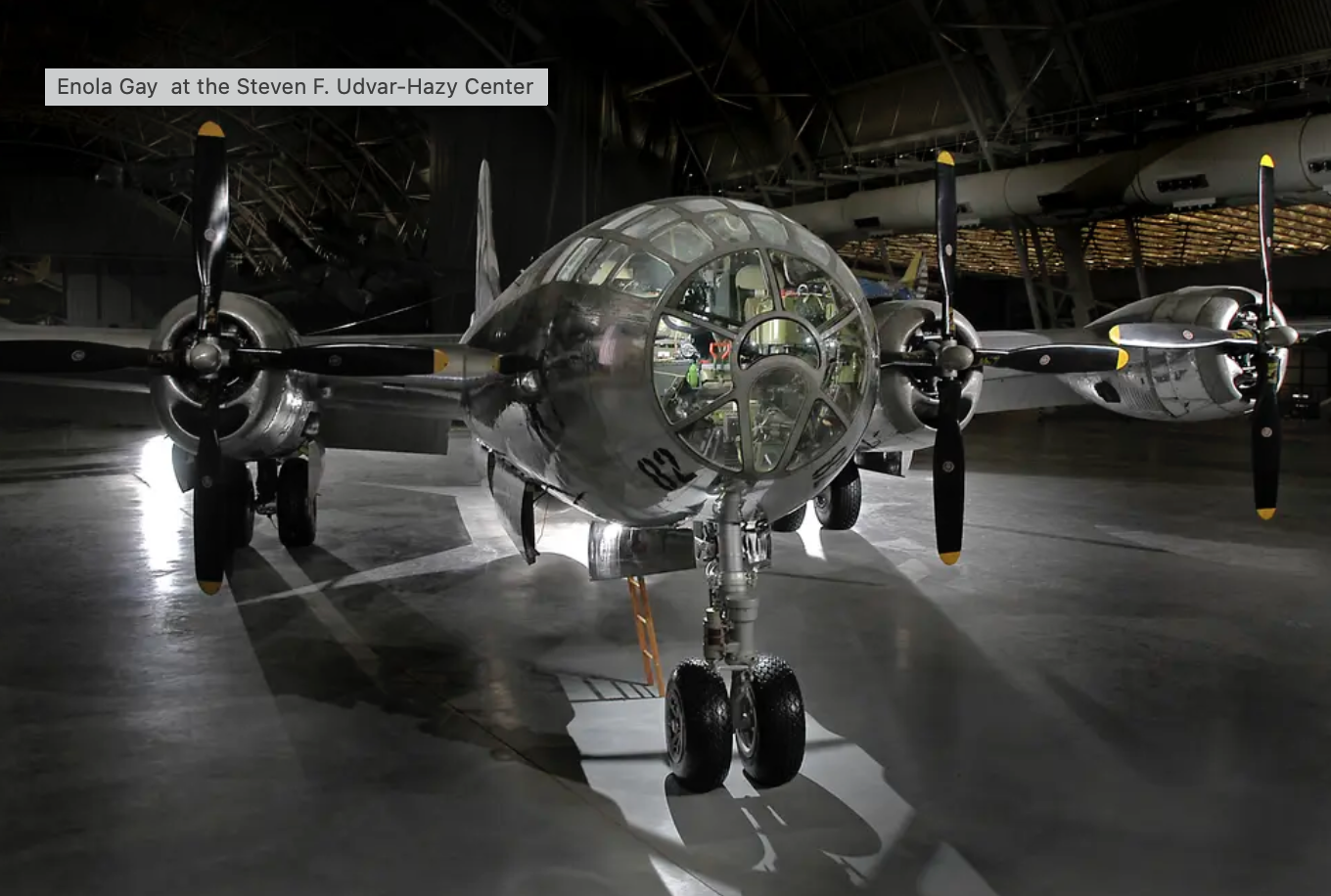
The Enola Gay has had a very long journey to end up in the Steven F. Udvar-Hazy Center, and part of that journey included San Diego.
The Grumman F3F-2, Bureau Number 0976, presented a different challenge. Marine pilot Robert E. Galer had ditched the fighter off the San Diego coast on August 29, 1940. The aircraft was located on the ocean floor in 1988 and recovered in April 1991 after roughly half a century underwater. Saltwater immersion, corrosion, missing components, and the rarity of the type made the restoration unusually demanding. Museum staff and volunteers restored the aircraft for the National Museum of Naval Aviation, where it remains on display. The project joined local history, underwater recovery, naval aviation, and exacting technical restoration in one airframe.


The Grumman F3F-2’s journey through restoration, from the ocean floor to museum display.
Together, the Enola Gay engines and F3F-2 established an important dimension of the Museum’s identity. The restoration program was not limited to preparing its own galleries. It could serve as a center of expertise for objects of national significance and build relationships with institutions whose collections extended far beyond San Diego.

The F3F on display at the National Naval Aviation Museum in Pensacola, Florida.
The program’s growing reputation also exposed a practical limit: the Museum needed more space for aircraft requiring years of work, large assemblies, and specialized equipment.
2001 Pan American Plaza, San Diego, CA
Phone: 619.234.8291
Información En Español
Contact Us
We would like to thank all our sponsors who help us make a difference. Click here to view all who help us.

The San Diego Air & Space Museum is a 501(c)(3) non-profit organization. Federal Tax ID Number 95-2253027.