After the war, aerospace employment did not simply return to its earlier form. Commercial aviation expanded. Airlines needed pilots, mechanics, dispatchers, reservation agents, baggage handlers, flight attendants, air traffic specialists, maintenance crews, and administrative staff. Airports became larger and more complex. Passenger travel created new kinds of public-facing aviation work, while cargo and maintenance work continued growing behind the scenes.

This Cold War view of Lindbergh field highlights its transformation.
The Cold War brought another shift. Aerospace work became more specialized as military aviation, missile programs, electronics, radar, guidance technology, telemetry, computing, and spaceflight expanded. Companies such as Convair moved from aircraft production into missile and space-related programs. The Atlas missile program in San Diego reflected this broader transition from conventional aircraft manufacturing into missile and space work that required new levels of engineering coordination, testing, documentation, and technical control.

An Atlas missile undergoing tests in Convair's San Diego factory.
Workers had to adapt again. Manufacturing, inspection, drafting, engineering, technical support, clerical work, and management all changed as tolerances narrowed and documentation expanded. New categories of expertise developed around electronics, guidance technology, computing, launch operations, and complex program coordination. Aerospace was no longer only about building aircraft. It was becoming tied to rockets, missiles, satellites, communications, and eventually human spaceflight.
The space program made the scale of hidden labor even clearer. Public attention centered on astronauts, and understandably so. They accepted visible risk and became the human face of national ambition. But human spaceflight depended on workers spread across factories, laboratories, launch sites, tracking stations, military facilities, universities, contractors, and government agencies. The early human spaceflight programs widened that labor step by step. Mercury had to prove that a person could be launched, tracked, recovered, and kept alive inside a spacecraft. Gemini added longer missions, rendezvous, spacewalks, and more complicated orbital operations. Each stage brought more people into the work: engineers, technicians, recovery crews, medical teams, programmers, contractors, military personnel, and workers at tracking stations, factories, laboratories, and launch sites.
By the time Apollo moved toward the Moon, human spaceflight had become an enormous national and industrial effort. Spacesuits had to be sewn and tested. Computers had to be programmed. Trajectories had to be calculated. Components had to be built, checked, documented, transported, installed, and reviewed. Mission control, communications inspection, manufacturing, mathematics, and military coordination all had to work together. The Moon landing became a single public event, but it rested on labor distributed across thousands of people, many locations, and years of preparation.


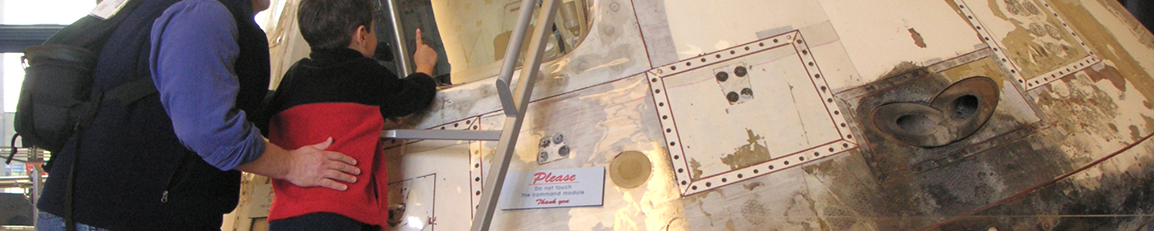
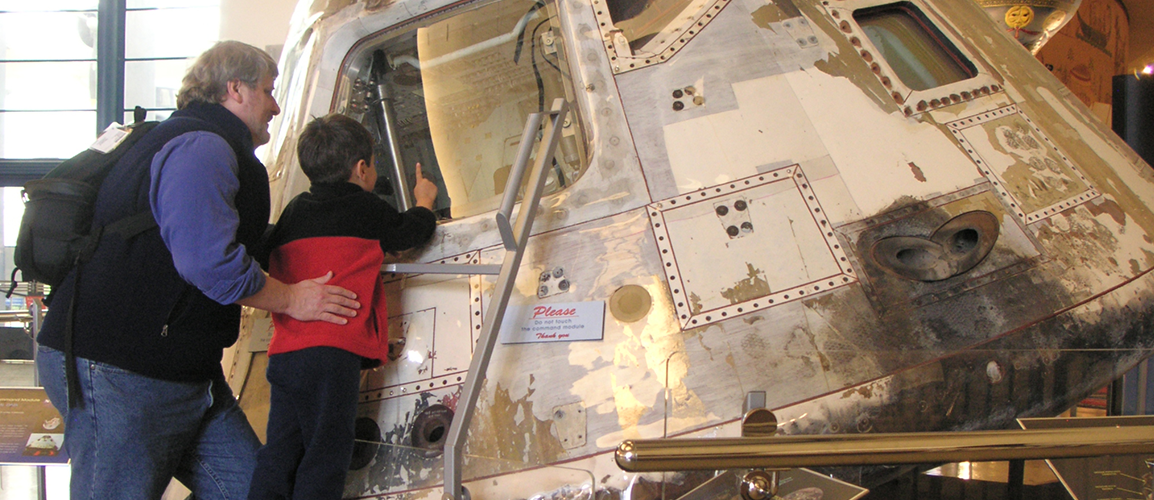
A couple of items from our collection celebrating the first moon landing.
Some of that work remained unrecognized for decades. African American mathematicians, engineers, and programmers at NASA contributed to trajectory calculations, orbital mechanics, launch windows, and flight operations during the Mercury, Gemini, and Apollo eras while working within segregated or unequal professional environments. Later attention to these workers changed public understanding of the space program by showing how much expertise had been present but overlooked. That correction matters because aerospace history has often been told from the top. The surviving aircraft, official photographs, program names, and milestone dates can pull attention toward leaders and public figures. Records from factories, payroll offices, engineering rooms, newsletters, training programs, and personal collections help widen the view. They show how many people were involved and how varied their work was.
A photograph of workers standing beside an aircraft can say more than the identity of the machine. It can show clothing, age, gender, race, tools, workspaces, posture, and pride. A technical drawing can show revision and problem-solving. A factory newsletter can show morale, accidents, production goals, and social life. An oral history can preserve exhaustion, humor, discrimination, skill, fear, and memory that do not appear in official summaries. These sources keep the labor from disappearing behind the object.

This image from our Rohr collection shows the camaraderie of aerospace workers that went beyond the factory floor.
Aerospace work also carried instability. Employment rose and fell with military spending, defense contracts, canceled programs, changing technologies, and shifting national priorities. A factory could expand quickly and later contract. A program could promise long-term work and then disappear. Families tied to aerospace jobs often lived withuncertainty even when the industry appeared powerful from the outside. That instability has not disappeared. Modern aerospace is again changing the nature of work through automation, artificial intelligence, autonomous systems, reusable rockets, digital engineering, robotics, commercial spaceflight, satellite operations, cybersecurity, and remote sensing. Some work once done by large physical teams now depends on software, simulation, and automation. At the same time, new forms of labor are emerging around design, monitoring, maintenance, regulation, security, and accountability.

Modern aerospace manufacturing can look a lot different than it did in the past.
American aerospace was built by millions, not only by the few whose names became attached to famous moments. The aircraft, missiles, rockets, satellites, airports, factories, and space systems that shaped modern America were made possible by people whose names often remained far from public attention. To understand aerospace as part of modern America, the story has to move beyond the cockpit, the launch pad, and the famous photograph. The larger history is found in the people whose work made those symbols possible.
2001 Pan American Plaza, San Diego, CA
Phone: 619.234.8291
Información En Español
Contact Us
We would like to thank all our sponsors who help us make a difference. Click here to view all who help us.

The San Diego Air & Space Museum is a 501(c)(3) non-profit organization. Federal Tax ID Number 95-2253027.