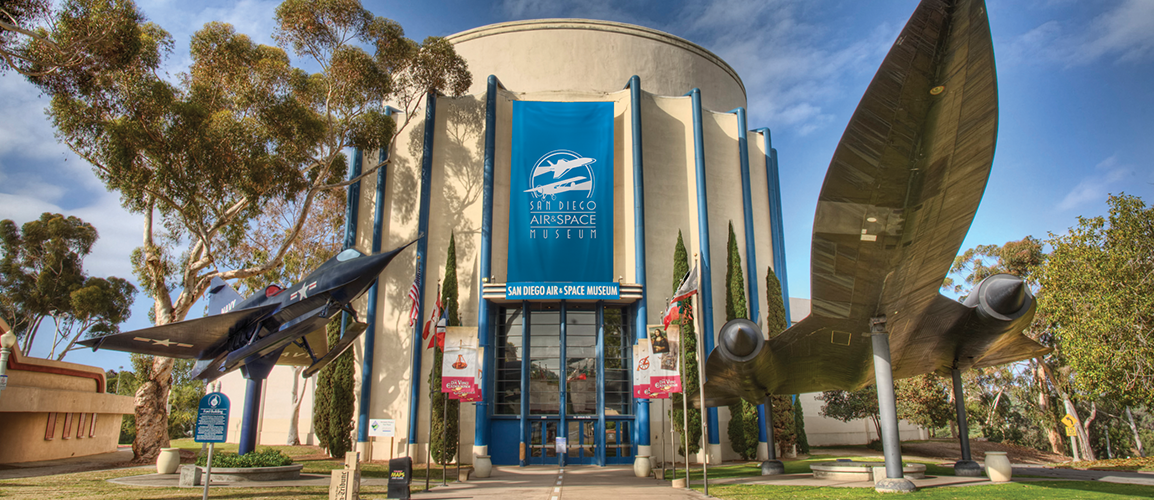

The San Diego Air & Space Museum Library and Archives houses some of earliest images taken in California that show one man's vision of how we can take to the air.

The moon rock on display near the exit of the Space Exhibit inside the San Diego Air & Space Museum was collected by the astronauts of Apollo 17, the last manned mission to the moon in 1972. The sample we have is particularly important in U.S. space exploration history, since it came from the area where the age and method of creation of the moon were determined. This was one of the major scientific goals of the Apollo program.
Gathering samples from the moon’s surface was so important to NASA that Neil Armstrong’s instructions were to do so as soon as he stepped onto the moon’s surface. He was to put rock samples into a pocket in his spacesuit so that he and Buzz Aldrin would have something to bring back to earth in case they had to leave suddenly. It is no surprise, then, that the box designed to hold their moon rocks, dust, and core samples was one of the most important pieces of equipment they brought to the moon

During the Cold War, Nuclear War was a real threat. However, we have a few films in our Archive that prove that if you just follow a few safety precautions, you would have nothing to fear!
The San Diego Air and Space Museum's Curatorial collection houses several artifacts that relate to the Hindenburg Airship Disaster that occurred in May of 1937.
2001 Pan American Plaza, San Diego, CA
Phone: 619.234.8291
Información En Español
Contact Us
We would like to thank all our sponsors who help us make a difference. Click here to view all who help us.

The San Diego Air & Space Museum is a 501(c)(3) non-profit organization. Federal Tax ID Number 95-2253027.