
The San Diego Air & Space Museum's Spirit of St. Louis.
From the actual Apollo 9 Command Module, to a flight worthy replica of Charles Lindbergh’s Spirit of St. Louis, to experiencing life on the lunar surface at Moon Base San Diego, the San Diego Air & Space Museum is your home for aviation and space exploration adventures this Summer!
Here 10 of the top experiences you’ll enjoy when visiting the San Diego Air & Space Museum.

Apollo 9 Command Module “Gumdrop”
One of only eleven Apollo command modules on display in the world, Apollo 9 was the third manned Apollo mission and the first space test of one of the most critical pieces of Apollo hardware: the Lunar Module (LM). It was up to the crew of Apollo 9 to test the ungainly-looking LM, the third component of the Apollo space vehicle system. The mission would require undocking and then re-docking the LM with the Command Module (CM), a procedure necessary for the eventual lunar landing missions. Because the Lunar Module and Command Module would separate during the mission, each having its own radio call sign, the Apollo 9 crew nicknamed the two spacecraft. With its gangly features, the LM was dubbed “Spider.” When the Command Module was delivered to NASA by its manufacturer, North American Rockwell of Downey, California, it was wrapped in a blue covering that gave it a distinct candy-like appearance. It was fittingly, dubbed the “Gumdrop.”

Lockheed A-12 “Blackbird”
The A-12, the first of three different versions of the Blackbird, was secretly developed by Lockheed for the Central Intelligence Agency (CIA). Lockheed developed the Blackbird to provide a Mach 3 replacement for the U-2 spy plane. Located just outside our main entrance in Balboa Park, the Museum’s Blackbird was the tenth A-12 ever built. This airplane was used by the CIA for five years to fly operational missions over Southeast Asia before it was retired in 1969 and put into storage at Palmdale, California. After restoration by Museum and Convair volunteers, the aircraft was transported to Balboa Park in front of the Museum in 1991.

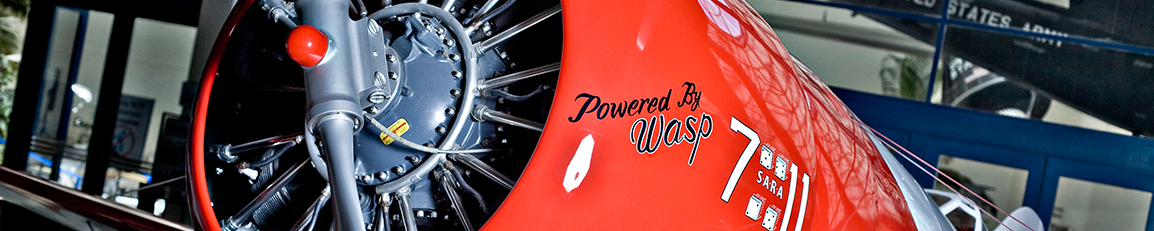
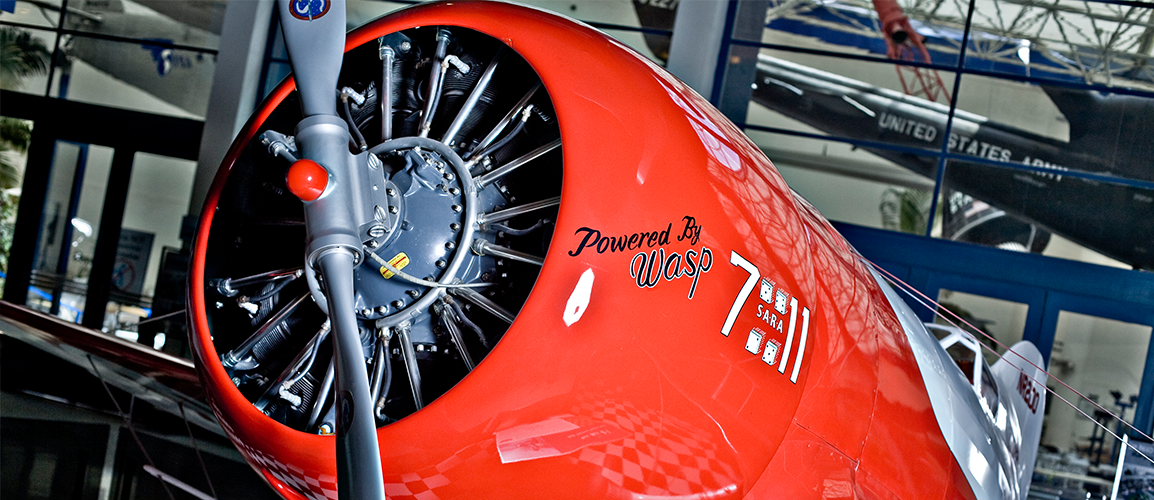
Gee Bee Racer
The Gee Bee Super Sportster R-1 classic airplane was designed by the Granville Brothers, a name which became famous during the Golden Age of Flight. Granville Brothers Aircraft was a relatively small aircraft repair business based out of Springfield, Massachusetts, owned by five brothers known as “The Granville Brothers,” hence “GB” or “Gee Bee.” The Gee Bee design rationale was to fit the most powerful engine available into the smallest airframe possible. The Museum’s Gee Bee was built from the ground up by Museum volunteers using original plans obtained from the New England Air Museum, and is one of only a few on display in the world.

Moon Base San Diego
Moon Base San Diego is a family-friendly activity and education center offering hands–on, interactive and immersive learning activities for explorers of all ages who want to experience a trip to the Moon. Moon Base San Diego’s habitat immerses families in life on the Moon with living quarters and a lunar surface they can experience and explore. Children visit a NASA lunar lander capsule, taking on the roles of pilot and astronaut. An interactive wall gamifies learning about life on the Moon. In the center of the room, children of all ages can sit and interact around tables teeming with interactive learning materials.

GPS Satellite
The Global Positioning System, commonly referred to as GPS, is one of the most significant recent advancements in Earth navigation. It uses a network of Earth orbiting satellites, transmitting precise microwave signals to Earth. This system permits space identification of any location on Earth and navigation from one location to another. Satellites have especially revolutionized communications. Global news events can be watch in real time anywhere in the world and phone calls can be easily routed to any city in the world. The Museum’s GPS satellite is the only one of its kind on display in the world and hangs above the Space: Our Greatest Adventure special exhibition.

F/A-18 Hornet “Blue Angels 1”
The F/A-18 Hornet is a supersonic, all-weather carrier capable multi-role fighter jet, designed to attack both ground and aerial targets. The Museum’s F/A-18 Hornet was flown by the US Navy’s famous Blue Angels Flight Demonstration Squadron. The Blue Angels show season runs each year from March until November. They perform at military and civilian airfields and often perform at major cities such as San Diego, San Francisco, and Seattle during “Fleet Week” maritime festivals. During the aerobatic demonstrations, the Blue Angels operate six F/A-18 Hornet aircraft, split into the Diamond (Blue Angels 1 through 4) and the Lead and Opposing Solos (Blue Angels 5 and 6). Most of the show alternates between maneuvers performed by the Diamond and those performed by the Solos. The Museum’s Hornet is on display in the Modern Jet Age Gallery.
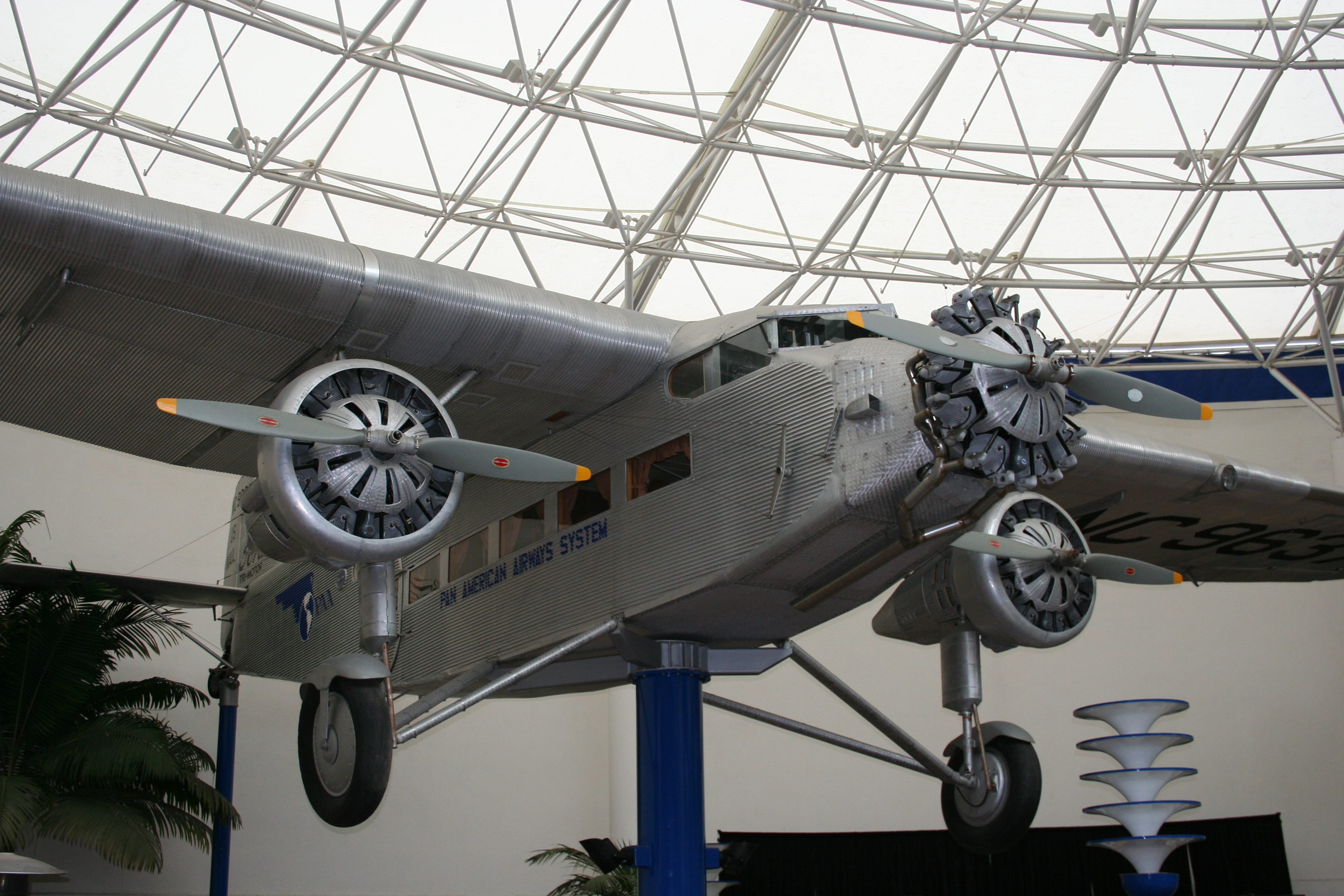
Ford Trimotor
Beginning in 1925, The Ford Motor Company, by then well known for successfully mass producing reliable inexpensive cars, entered into the uncertain and risky realm of aircraft design and production business. The Ford Trimotor, or the “Tin Goose,” as it was affectionately nicknamed, was undeniably the best product to come out of the endeavor. More than any other aircraft up to that time, the Trimotor had a profound effect on the early advancement of commercial aviation. The Ford Trimotor is on exhibition in the Pavilion of Flight, near the Museum’s two 1930s V-8 Ford cars, as a testament to Ford’s major role in the development of transportation in the twentieth century, both on the ground and in the air.
Spirit of St. Louis (Replica)
When Charles A. Lindbergh and his Ryan monoplane, the Spirit of St. Louis, touched down at Le Bourget Field at 10 p.m. on May 21, 1927, both man and machine had made history. The first non-stop New York-to-Paris flight was complete in 33 hours and 30 minutes in a plane that was designed, built and tested right here in San Diego! The flight was inspired by the $25,000 Ortieg Prize for the first non-stop transatlantic flight. Lindbergh received the prize and the acclamation of nations around the world. The Museum’s flight-worthy replica of the Spirit of St. Louis greets visitors in the entrance Rotunda, where it was placed on display on November 4, 2006, to coincide with the International Air and Space Hall of Fame Celebration Gala.

Max Flight Simulator and Interactive Ride
The Dual-Seater is ready to duel! The FS2000 Two-Seat Flight Simulator is part of an all-new, sleek squadron of indoor full-motion multi-role aircraft rides. Each is poised for the sharp banks, sky loops and screaming dives of pulse-pounding aerial combat and is completely controlled by the pilots themselves! The 360-degree pitch, roll, spin and spiral action is real while riders fly any one of Max-Flight’s combat and flight training programs on a huge 58” screen in the cockpit. Faster, sharper and more exciting than any indoor thrill-ride on the market, the FS2000 lets guests be pilot or gunner or both as they engage in interactive dog fighting, carrier landings, flight training and aerobatic maneuvers with the finest, most realistic graphics available. You must be at least 44 inches tall to be able to go on the Interactive Ride.

Flight Path Grill & Observation Deck
Located on the back deck of the Museum overlooking stunning views of downtown San Diego, the Flight Path Grill gets its name from the fact that it is literally “in” the flight path into San Diego International Airport where aircraft from all over the world arrive daily. The Flight Path Grill also offers a wide variety of affordable and delicious food and beverages, making any trip to the Museum and day worth savoring. From burgers, hot dogs and wraps, to nachos and sweet treats, as well as beverages for all ages, the Flight Path Grill is the perfect spot to fuel up for a day of adventures and lasting memories at the San Diego Air & Space Museum.
2001 Pan American Plaza, San Diego, CA
Phone: 619.234.8291
Información En Español
Contact Us
We would like to thank all our sponsors who help us make a difference. Click here to view all who help us.

The San Diego Air & Space Museum is a 501(c)(3) non-profit organization. Federal Tax ID Number 95-2253027.