Among the uniforms and flight gear preserved in the Museum’s collection are artifacts that represent not only military service, but individual decisions made at pivotal moments in history. The collection of Captain Stanley Millick Moore Anderson offers a powerful example. His service spanned two air forces, two fighter aircraft, and some of the most consequential air combat operations of the Second World War.

Captain Stanley Anderson (Stanley Millick Moore Anderson) Artist: Leslie Emery, 1946.
Before the United States formally entered the war, Anderson volunteered to fight. In February 1941, he enlisted in the Royal Air Force Volunteer Reserve and joined No. 71 Squadron, one of the famed Eagle Squadrons. These squadrons were composed of American pilots who crossed the Atlantic to join Britain’s defense during its most vulnerable period. Flying the Supermarine Spitfire, Anderson trained and operated from RAF stations in England, including Martlesham Heath and Debden, where Eagle Squadron pilots participated in fighter sweeps and defensive patrols over occupied Europe.
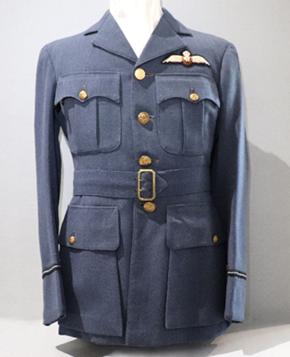
Jacket, Royal Air Force (RAF) American Eagle Squadron, of Stanley Anderson.
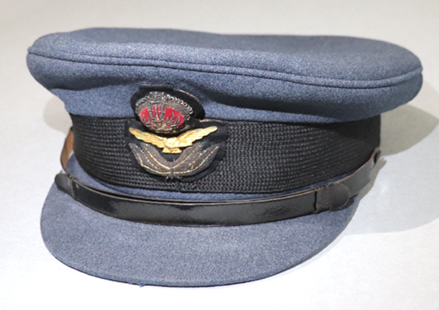
Hat, Royal Air Force (RAF) American Eagle Squadron, Pilot Officer cap of Stanley Anderson.
One of the defining moments of his service came during Operation Jubilee, the Allied raid on Dieppe, France, on August 19, 1942. The operation involved intense air combat as Allied fighters protected ground forces and engaged German interceptors. Anderson flew combat missions during the raid, contributing to one of the largest air engagements on the Western Front at that time.
Only weeks later, on September 29, 1942, the Eagle Squadrons were formally transferred from the Royal Air Force into the United States Army Air Forces. Anderson became part of the 334th Fighter Squadron, 4th Fighter Group, 8th Air Force. His transition represented a unique moment in aviation history, as American pilots who had volunteered to fight under British command were absorbed directly into the U.S. military, bringing with them invaluable combat experience.
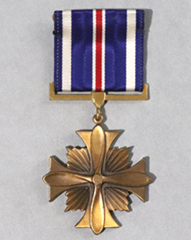
Medal, Distinguished Flying Cross (DFC) of Stanley Anderson (Awarded posthumously).
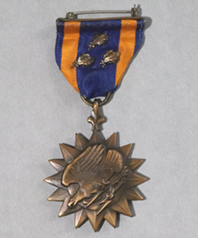
Air Medal (AM) with three Oak Leaf Clusters of Stanley Anderson (one oak leaf was awarded posthumously).
His Distinguished Flying Cross and Air Medal reflect this period of sustained combat service. Shortly after transferring to U.S. command, Anderson shot down an enemy Focke-Wulf Fw 190 aircraft over occupied France near St. Nazaire on October 2, 1942, flying a Spitfire. His combat performance earned formal recognition, including the Air Medal presented by General James Doolittle later that year.
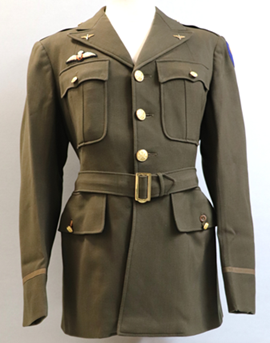
Jacket, U.S. Army Air Forces service dress coat of Stanley M. Anderson.
The artifacts preserved in the Museum’s collection trace this progression across air forces and aircraft. His Royal Air Force Eagle Squadron jacket and pilot officer’s cap represent his early service as a volunteer defending Britain. His U.S. Army Air Forces service dress coat, British-made but worn under American command, reflects the continuity between these roles. Together, these uniforms illustrate a unique transitional moment when American pilots carried their experience from one air force directly into another.
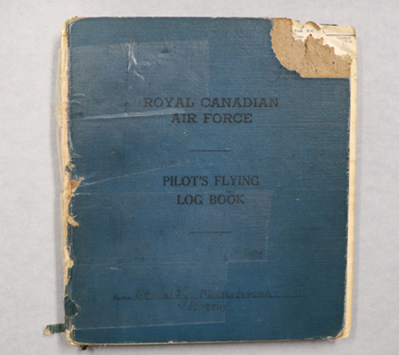
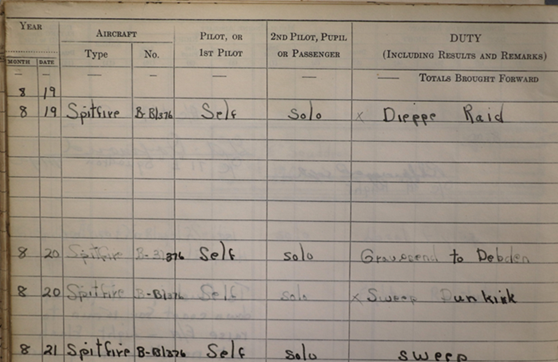
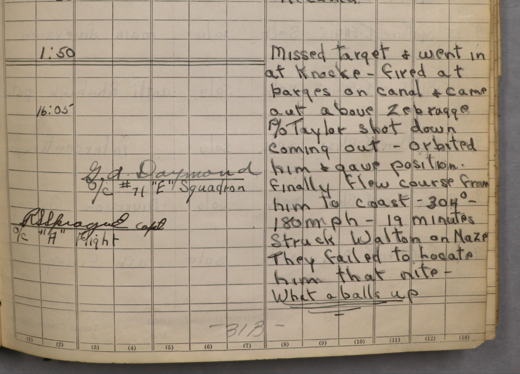
Pilot log book of Stanley M. Anderson (RCAF, RAF, Eagle Squadron, USAAF); 1941-1943.
Perhaps the most personal artifact is Anderson’s pilot logbook. Beginning with his initial training in Canada in 1941, the logbook records his development from trainee to combat pilot. Its entries document his initial flight training with RCAF in June 1941, then continues with notes on logging exercises and skills, his transfer to Chester, England in Dec. 1941, joining 71 Eagle Squadron in Suffolk in March 1942, the Squadron move to Debden in June 1942, the Dieppe Raid in August 1942, his transfer and first flight under "U.S. colors" in early October 1942, and #334 Fighter Squadron interactions with the enemy over France.His last entry in this book was flying a P-47 "Circus St. Omer" on April 8th 1943. The Museum also holds an additional log book from Anderson detailing his flights from 1943-1944.
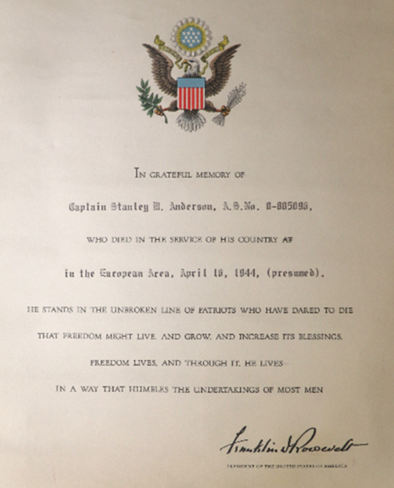
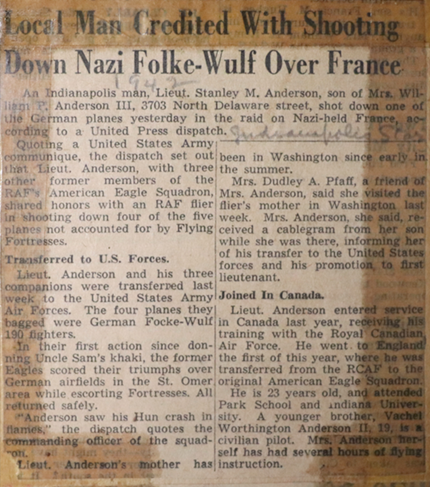
Official notice of death letter for Stanley Anderson and newspaper article detailing his combat experience.
By 1944, Anderson was flying the Republic P-47 Thunderbolt, one of the most powerful fighter aircraft of the war. On April 15, 1944, while flying Thunderbolt 41-6407 over the North Sea near the Belgian coast, his aircraft was attacked by a German Focke-Wulf fighter. He was reported missing in action and declared dead the following day.
He was twenty-six years old.

Lt. Col. Chesley G. Peterson D.S.O., D.F.C., U.S. Army Air Force 4th, who formerly commanded the old Eagle Squadron, in front of his Spitfire, has a talk with his flight group. They seem very pleased with the raid they are going to carry out. (L-R) Lt Robert Boock, Lt James Clarke, Captain William T O'Regan, Lt-Colonel Chesley G Peterson, Captain Richard McMinn, Captain Stanley Anderson and Captain Oscar Coen. Photo courtesy of IWM American Archive americanarchive.iwm.org.uk
Today, his name is inscribed on the Tablets of the Missing at Henri-Chapelle American Cemetery in Belgium, alongside other airmen whose remains were never recovered.
The artifacts in this collection preserve more than his rank or assignments. They preserve evidence of a decision to volunteer before his country required it, to continue flying under a new command structure, and to remain in combat until his final mission. The objects kept by Anderson’s family also reflect the heavy toll the War took on the families back home. Numerous photos and newspaper clippings like those seen here were loving collected by his mother and stored in scrapbooks. Mrs. Anderson also lost another son, Stanley’s younger brother Vachel. Vachel Anderson was serving with the 2nd Squadron, 443rd Troop Carrier Group in the China-Burma-India theater when his transport aircraft crashed on September 14, 1945, killing all 39 aboard. Within one year, Mrs. Anderson lost two of her three sons, the other being too young to serve.
Through his uniform, medals, and logbooks, Captain Stanley Anderson’s story remains part of the historical record. His service reflects the role of individual pilots in shaping the Allied air war, and the Museum is honored to preserve these artifacts so future generations can understand both the scale of the conflict and the individuals who fought it.
2001 Pan American Plaza, San Diego, CA
Phone: 619.234.8291
Información En Español
Contact Us
We would like to thank all our sponsors who help us make a difference. Click here to view all who help us.

The San Diego Air & Space Museum is a 501(c)(3) non-profit organization. Federal Tax ID Number 95-2253027.